While I was learning about queueing systems, I was presented with the M/M/1 queue and its formulas. I knew that the M/M/1 queue came from Markov chains, and that the M stood for a Markovian process, and I knew a little about Markov chains too — but the connection between them was never clear.
I spent some time learning about it, and this article is the result. We will go from the introduction of Markov chains all the way to the derivation of the M/M/1 queue.
Introduction to Markov Chains
We will take one example of a service center and build up on that.
In our example, let us assume that in each time frame (say 1 minute) there is a probability
And suppose our service center only has 5 computers, so we can only have that many customers at a time. It can be represented as below. Each circle is a state showing how many customers we have in our system right now. We have 6 states because that's all we can have with 5 computers; there can be either 0 customers at any time, or one, or two, and so on up to five customers.
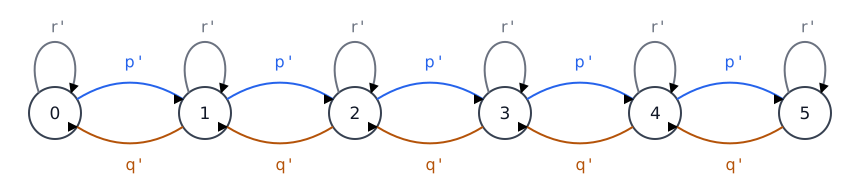
It also shows how we can move from one state to another.
We can only move from state
Similarly, we can only move from state
And to stay in the same state, either someone has to come and another one has to go, or no one can come or go. So the probability of that happening is the probability of one leaving and one coming, plus the probability of no one coming and no one going:
Summing all of these probabilities results in 1.
This is the Markov chain that models our service center.
With all this said, let us cover some terminology, and then we will connect it back to this example.
Analysis of a Markov Chain
What makes the above model a Markov chain? It qualifies as a Markov chain because it does not depend on the past.
You can be completely blind about your past and about how you reached your current state. All you know is that you can either go to the next state with some probability, or go back, or stay where you are.
What it is saying is that the conditional probability of being in state
Now, we can also define the probability that you go from state
Initially we are at state
That's the recursive formula for
If the process starts in state
, then after zero moves it remains in state with probability 1. Therefore the probability of being in any different state after zero moves is 0.
We can also define it the other way around:
This is just the other representation of the previous result: the probability of going from
We will use the results above to solve a simple example.
Suppose we have a Markov chain with two states,
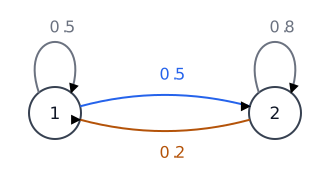
The transition probability matrix is
Let
The transition probabilities for different values of
For example, to calculate
Therefore,
Similarly, the other two-step transition probabilities can be calculated by considering all possible paths of length two.
We observe a remarkable pattern: as
Thus, regardless of whether the process starts in state
These limiting probabilities are called the stationary probabilities, denoted by
This observation raises a natural question.
Does this convergence occur for every Markov chain? In other words, is it always true that
for every pair of states
It depends. It depends on the Markov chain. If all recurrent states belong to a single recurrent class, and this class is not periodic, then the transition probabilities converge to a limiting distribution, under the usual finite-state assumptions.
We will not discuss recurrent states, recurrent classes, or periodicity in detail here, but these concepts are not too difficult to understand.
If the transition probabilities converge, we can derive equations for the limiting probabilities.
We already know:
Taking the limit as
Since
Therefore,
These equations give us one equation for each state
since the total probability of being in any state must equal 1.
Thus, by solving this system of equations, we can determine the steady-state probabilities
Birth-Death Process
We will now finally return to our old customer service example and give it a name. This kind of process is called a birth-death process.
It is simple: either there can be one birth and we move to the next state, one death and we move to the previous state, or we stay in our current state.

Let us analyse this birth-death process, since it will be used directly for our M/M/1 queue.
First, let us pick one section of this chain:
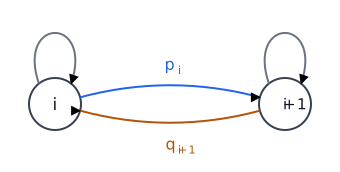
If the process runs long enough and reaches a steady state (birth-death processes satisfy the conditions on recurrent states and periodicity mentioned earlier), there must be a balance between the flow into and out of each state.
Why? It balances out. For example, if
The probability of a transition from state
Similarly, the probability of a transition from state
Now we can see that, in the first case,
These balance out, and we get
Therefore,
We can simplify our model further by assuming that
Rearranging, we get
Therefore,
and
So, in general, letting
we get
We know that the sum of all steady-state probabilities must equal
Substituting the expressions above, we obtain
Therefore,
where the denominator is the sum of a geometric series.
The M/M/1 Queue
For an M/M/1 queue, we suppose that the queue length is infinite. That is, we let
For a stable queue we have
We know that the sum of a geometric series is
Therefore,
Recall that
Now, in an M/M/1 queue, both the arrival process and the service process are assumed to be Poisson processes. Equivalently, the interarrival times and service times follow exponential distributions.
For an exponential distribution with rate
The cumulative distribution function (CDF) is
The hazard rate is defined as
Here, the hazard rate
For the exponential distribution, we obtain
Thus the hazard rate is constant. This is exactly the memoryless property of the exponential distribution: the probability of an event occurring within the next time interval does not depend on how long we have already waited.
Therefore, if arrivals follow a Poisson process with rate
Similarly, if the service process completes services at rate
and so
With these probabilities, we get something like this. From state
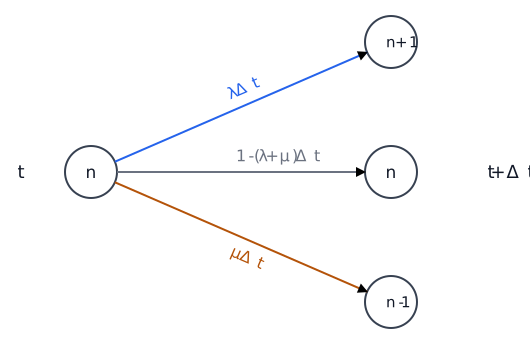
And in a more general view:

Finally, it's time to derive the other queue parameters.
where
where
From Little's law,
.
where
where
Why just the M/M/1 queue? Why not others?
If you look at what we did, we used the memoryless property of the exponential distribution to define the probabilities of the birth-death process.
That property is really what made the whole thing work. Because the hazard rate is constant, every jump has a fixed probability, no matter how long the system had already been sitting in its current state.
So the method is not tied to M/M/1 at all. As long as the process stays Markovian, we can reuse it.
Take the M/M/3 queue, where we have 3 servers instead of 1:

The only thing that changed is the backward probability. With more than one server, more than one customer can be served at a time, so departures get faster until every server is busy.
In state
The local balance equation between neighbouring states is the same one we derived before, just with
Starting at state zero,
In general,
Now take away the exponential service time.
If the hazard rate
At that point you need a different tool. For example, in this video, he used a triangle method. (I am plugging this video here to suggest that you should watch it, it is a good talk on this subject)